







Key takeaways
- AI search is when you ask a question and get one written answer with a few sources named inside it, instead of a page of ten blue links.
- It isn’t one system. ChatGPT, Perplexity, Claude and Google’s AI answers each choose their sources differently, so being visible in one doesn’t mean being visible in all.
- The shift is already at scale: ChatGPT reached 800 million weekly users in 2025 and Google’s AI Overviews now reach 2 billion people a month.
- The biggest change is that there’s no page two. You’re named in the answer, or you’re invisible. Being ranked eighth no longer saves you.
- What earns you a mention is being clearly structured and widely referenced across the web, not just ranking high on your own page.
Search is going through its biggest change in twenty years, and most teams haven’t adjusted their strategy yet. For two decades, the goal was simple: rank on Google, earn the click. That’s still part of it. But a growing share of people now ask ChatGPT, Perplexity or Google’s own AI a question and read the answer without clicking anything at all. ChatGPT alone reported 800 million weekly active users at OpenAI’s DevDay in October 2025, a figure the company put at 900 million by February 2026. On Google’s side, AI Overviews reached 2 billion monthly users in mid-2025.
This guide explains what AI search actually is, how the main surfaces differ, and why it changes what “being visible” means for your brand.
What “AI search” actually means
AI search is any experience where a model answers your question directly, in its own words, and names a handful of sources or brands inside that answer, rather than returning a list of links for you to sort through yourself.
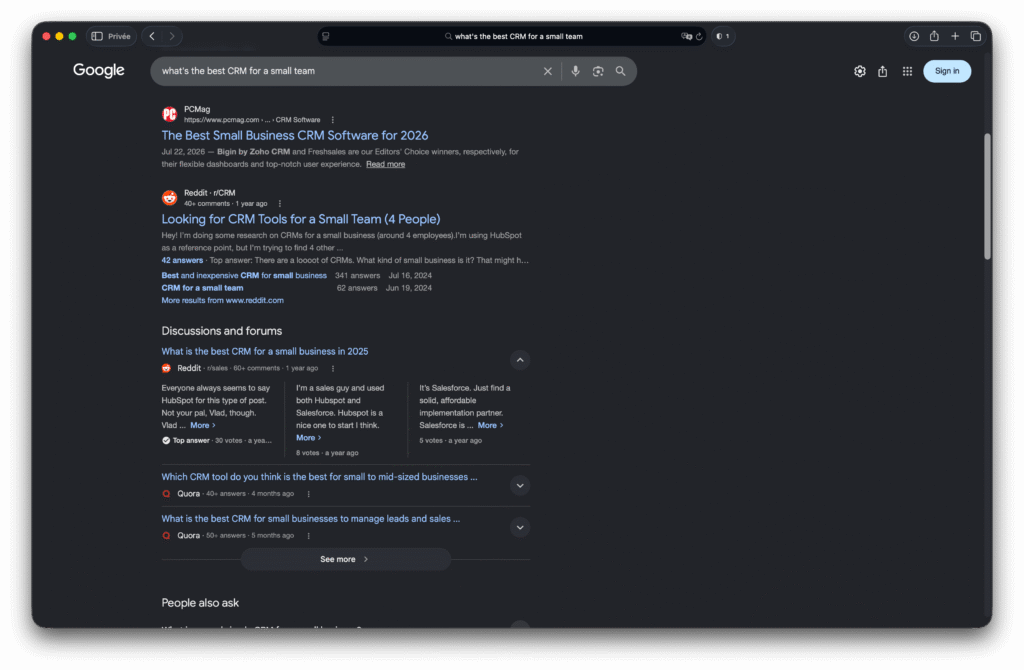
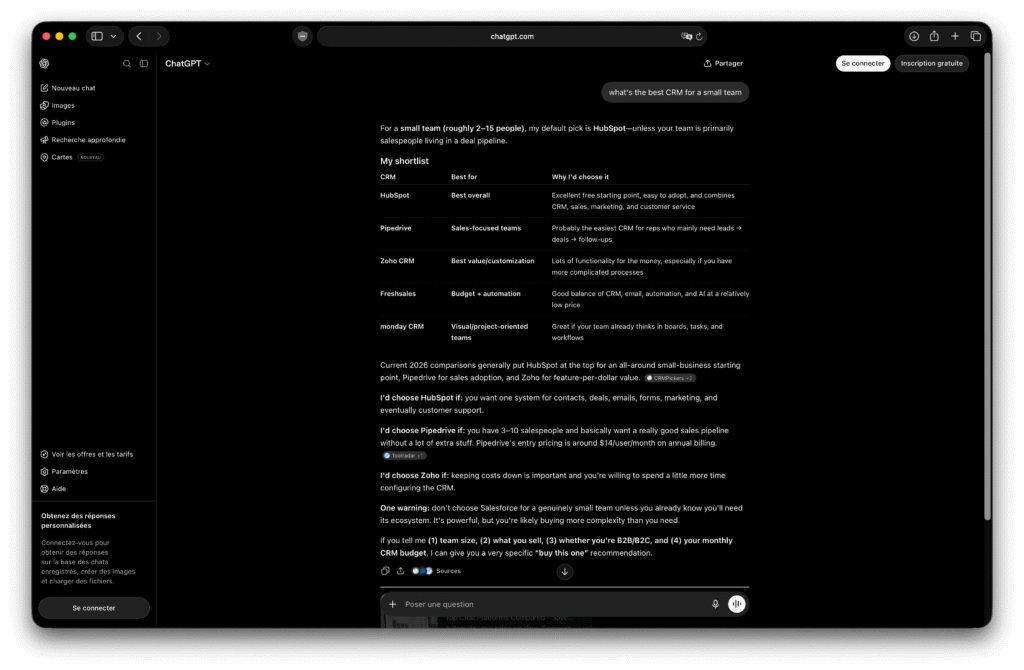
Ask a traditional search engine “what’s the best CRM for a small team” and you get ten links. Ask an AI assistant the same thing, and you get a short written recommendation naming two or three tools, sometimes with citations, sometimes without.
The mechanics underneath vary, but two things are always happening: the model draws on what it learned during training, and, increasingly, it retrieves fresh information from the web at the moment you ask. Your job is to be present in both.
The main AI search surfaces (and how each picks sources)
“AI search” is not a single destination. The four surfaces your audience is most likely using each select sources in their own way, which is why visibility isn’t uniform across them.
ChatGPT leans on a mix of what it learned in training and live browsing when a question needs current information. Brands it “knows” tend to be the ones the web has discussed consistently over time.
Perplexity is retrieval-first. It searches the live web for almost every query and cites its sources openly, which makes it the surface where fresh, well-structured pages can surface fastest.
Google’s AI answers (AI Overviews, and increasingly AI Mode) draw on Google’s own index. Their reach on the results page is real but uneven: across a 10-million-keyword sample, AI Overviews climbed to close to a quarter of tracked searches by mid-2025 before settling lower later in the year, per Semrush data reported by Search Engine Land. Being cited here is related to, but not the same as, ranking: a well-structured page can be quoted even when it isn’t the top blue link.
Claude and other assistants add more variation still, each with its own retrieval behaviour and training data.
| Surface | How it picks sources | What tends to win |
|---|---|---|
| ChatGPT | Training knowledge plus live browsing when needed | Brands the web has discussed consistently over time |
| Perplexity | Retrieval-first, searches the live web on almost every query, cites openly | Fresh, clearly structured pages |
| Google AI answers | Google’s own index, surfaced in AI Overviews and AI Mode | Extractable pages that are related to, but not identical to, top rankings |
| Claude and others | Their own mix of training data and retrieval | Varies, but rewards clarity and wide referencing |
The practical takeaway: optimise for the pattern they share, be clearly structured and be widely referenced, because that’s what every one of them rewards. For how to do that on the page, see our guide on how to structure content to get cited by AI. If the acronyms around this are new to you, AEO vs GEO vs SEO untangles them.
How AI search is different from Google: there’s no page two
On Google, you can rank eighth and still get found. People scroll, they open a few tabs, they click through to page two when they’re determined. That safety net is gone in an AI answer.
An AI assistant doesn’t hand you ten options. It hands you a few names. You’re one of them, or, as far as that user is concerned, you don’t exist. There is no page two to rescue you.
This changes the goal. It’s no longer only “rank this page.” It’s “be one of the few sources the model trusts enough to name.” And that’s decided less by your own page and more by how the wider web describes you: the reviews, the comparisons, the communities, the coverage. Models surface the brands the web talks about most consistently, and that is often not the biggest or best-known name in a category. For the mechanics behind that choice, see how LLMs decide which brands to recommend.
What this means for your visibility, and what to do
None of this requires abandoning SEO. The fundamentals that win in AI search are, largely, good SEO practised with a slightly different emphasis.
Start with three things:
Be unmistakably clear about what you are. Use the same name, category and description everywhere, on your site and off it. If one source calls you a “project tool” and another a “CRM,” you make the model unsure what to recommend you for. Consistency is a signal.
Structure your content to be quotable. Lead with a direct answer, use clear questions and answers, keep the writing clean and specific. A model lifts the tidiest, most self-contained answer it can find. There’s a full walkthrough in how to structure content to get cited by AI.
Earn mentions where your buyers and the models look. Third-party references, reviews, comparisons and original data are what teach a model that you’re a source worth naming. This is the slowest lever and the most powerful one.
Frequently asked questions
Is AI search replacing Google?
Not replacing, but reshaping. Google itself now answers many queries with AI directly on the results page. At its I/O 2026 conference, Google made Gemini the default model in AI Mode for users worldwide and said AI Mode had passed 1 billion monthly users. At the same time, standalone assistants like ChatGPT and Perplexity handle a growing share of the questions people used to type into a search box. It’s better to think of search as splitting across more surfaces than disappearing.
Do I need a special file or schema to appear in AI answers?
No. There’s no magic “AI schema,” and you don’t need an llms.txt file to be included. Clear, honest content and clean, standard structured data are enough. Being widely referenced matters far more than any technical trick.
Can I get cited by AI without ranking first on Google?
Often, yes. Because AI answers reward the clearest, most extractable source, well-structured pages are sometimes quoted even when they don’t hold the top organic position.
How do I know if AI already mentions my brand?
Ask the assistants the real questions your buyers ask, and see who they name, then track it over time, because it moves. Measuring which brands AI recommends, month over month, is exactly what we do in the free Knownful AI Search Visibility Index.
Written by Matthis Duarte, a senior SEO and organic growth expert with 10+ years of experience driving organic growth for international brands across highly competitive verticals. He is the founder of Knownful, an independent publication on SEO and organic growth featuring in-depth guides, best practices, playbooks and original analyses, including a free monthly study of which brands AI actually recommends across 10 industries.